Dwell: Audio Bible
- 4.8
- Rating
- 1.00M
- Installs
- Free
- Price

 Analysis by App-foxy
I noticed the appeal of Dwell: Audio Bible almost immediately: it turns Scripture from something I have to sit down and read into something I can fit around the rest of my day. That sounds simple, but it changes the decision I make when I am tired, commuting, cooking, or trying to settle down before sleep. As a free Books & Reference app from Dwell App, LLC, it is built around listening rather than browsing, and that focus gives it a much clearer identity than a general Bible app.
My first impression was positive because the experience does not ask me to become an expert in the interface before I can hear anything. The store summary, “Press Play on Scripture,” is a fair description of the central idea, but the useful question is whether pressing play remains worthwhile after the initial novelty disappears. In my experience, the answer depends less on enthusiasm and more on whether you choose a listening routine that fits your real life.
From an easy first week to a useful routine
The first week is where the app makes its strongest case. Audio removes the small barriers that often stop me from opening a traditional Bible app: finding the right book, deciding how much to read, and staying focused on a screen. I can treat a passage as part of another activity without turning Scripture into background noise automatically. The difference is especially noticeable in moments when reading is inconvenient but listening feels manageable.
You May Also Like

 Blood Strike: 2.5 Anniversary
Blood Strike’s Loadouts Turn Every Drop Into a Tactical Gamble
A close look at Blood Strike’s custom loadouts: how fast access to signature weapons reshapes its battle royale rhythm, rewards preparation, and narrows the gap between fights.

 Pandora - Music & Podcasts
Pandora’s Music Is Easy to Start, but Harder to Recover
Pandora’s strength is its low-effort path from a seed to a station. Its weak spot is how much confidence it asks you to place in connection, setup, and quiet recovery.

 8 Ball Pool
 Is Built on Rivalries, Rematches, and Routine
A close look at the rivalries, rematches, shared routines, and unanswered safety questions that turn a quick pool match into a persistent mobile community.

 Samsung Music
’s Quiet Strength Is Playing What You Already Own
Its reach comes less from spectacle than from dependable access to a personal library. That simplicity is both the app’s strongest retention engine and its ceiling.

 AccuWeather: Weather Radar
AccuWeather Review: A Quick, Clear Forecast for Everyday Decisions
For everyday plans, the best forecast is the one you can understand quickly. AccuWeather makes rain timing, radar, and local conditions easy to act on, with a few trade-offs.

 Hill Climb Racing
Why Hill Climb Racing Still Turns Crashes Into One More Run
A tiny car, a bumpy hill and one more upgrade: Hill Climb Racing keeps resurfacing because its simple chaos makes every near-miss feel personal.
More From Our News Desk



For example, I can imagine using it while preparing breakfast, then switching to a short listening session during an evening walk. The important detail is not that every minute becomes a study session. It is that the app creates additional opportunities to encounter Scripture without requiring a separate block of quiet time. That makes it a realistic option for people whose good intentions regularly lose to a busy schedule.
I also found that audio changes how I notice familiar passages. Reading encourages me to control the pace and jump around visually. Listening makes me follow the order and hear the wording as a continuous piece. That can reveal the flow between paragraphs and chapters, although it also means I have less control when I want to inspect one sentence closely. I would not use this as my only Bible tool, but I found it valuable as a different way of paying attention.
The app’s audience is broad. Its content rating is Everyone, and the minimum operating system is Android 7.0, so it can suit people using older Android phones as well as those with newer devices. I would still judge the experience on the particular phone and listening setup I use, especially if I rely on an older device for long sessions, but the basic accessibility is a strength.
One practical tip helped me avoid abandoning it after a few days: I did not begin by promising myself an ambitious daily target. I started with a listening window that already existed in my schedule. A walk, a commute, or the final part of a bedtime routine is easier to repeat than a vague goal such as “listen more.” The app supplies the content, but the lasting habit comes from attaching it to something I already do.
Why audio feels different from the usual alternatives
A printed Bible gives me control, silence, and easy visual comparison. A standard digital Bible gives me search, highlighting, cross-references, and quick movement between passages. Dwell: Audio Bible earns its place by doing something those options do less naturally: making Scripture available when my eyes and hands are occupied. That is not a replacement for reading or study; it is a companion mode.
Compared with simply playing an audiobook version from a general audio app, a dedicated Bible experience feels more intentional. I am opening an app designed around Scripture rather than searching through a broad media library. That narrower purpose can reduce decision fatigue, particularly when I want to listen without spending several minutes choosing what to play.
The trade-off is equally clear. If my main goal is detailed study, I would choose a Bible app with strong reading tools or a physical Bible. If I want a wide collection of unrelated audiobooks, Dwell is too specialized. Its value comes from focus, and focus naturally means fewer reasons to open it outside this particular activity.
What becomes valuable after the first month
After the first burst of curiosity, the app has to become dependable rather than exciting. I think its recurring value comes from variety in how I use listening. One day it can support a quiet morning; another day it can fill a walk; on a difficult evening it can provide a calmer alternative to scrolling. The content does not need to feel new every time for the habit to remain useful, but my reason for listening needs to stay connected to a real situation.
I would not measure success only by how many chapters I complete. Audio can become a box-ticking exercise if I treat progress as the entire purpose. A better approach is to alternate between intentional listening and lighter exposure. For instance, I might listen carefully to a shorter passage when I have space to reflect, then use a longer session during routine work. That distinction prevents the app from feeling like another productivity obligation.
Another non-obvious strength is that listening can work well for people who find visual reading tiring. Screen fatigue, small text, or a crowded day can make a reading app feel like one more demand on attention. Audio removes that particular obstacle. It does not solve every concentration problem, but it gives me a way to continue when reading is the reason I would otherwise skip the session.
There is also a useful social angle, although I would keep expectations realistic. Someone who already discusses Scripture with family, friends, or a study group can use listening as preparation before a conversation. I might hear a passage first, then return to a visual Bible to examine details. The app is strongest in that two-step workflow: listen for continuity and context, then read when precision matters.
Its popularity suggests that this approach has found a substantial audience. Dwell: Audio Bible has a 4.7 average from around 14 thousand ratings, with more than 500 thousand installs. Those figures do not guarantee that it will suit me personally, but they do indicate that the audio-first idea is not merely a novelty for a tiny group of users.
Keeping the habit alive without making it feel like homework
The maintenance burden is fairly light at the habit level, but it is not zero. I need to decide when listening belongs in my day, keep my expectations reasonable, and notice when I am hearing words without absorbing them. The app can make access easier; it cannot create attention on my behalf.
I found it useful to keep two kinds of sessions. The first is a dependable default, such as listening during a regular walk. The second is a flexible session for days when the normal routine fails. Without that backup, missing one day can quietly become missing a week. With it, the habit has somewhere to go when my schedule changes.
I would also avoid using audio during activities that require serious concentration. Listening while driving may be convenient for some people, but safety should come first, and I would not let the app compete with traffic or demanding work. The best background activity is one where I can pause easily and still remain aware of what I am doing.
Because the app is free to install, it is easy to test without committing money at the start. However, in-app purchases range from $7.99 to $199.99 per item, so I would pay close attention to what is available at no cost and what requires a purchase before building my routine around a particular part of the experience. The free entry point is helpful, but the potential cost range makes it sensible to explore gradually rather than assume every appealing option is included.
That pricing structure is one of the main points I would explain to a friend. “Free” makes trying the app simple, but it does not mean the complete experience has no paid layer. I would use the free version first, decide whether I am actually listening consistently, and only then consider an in-app purchase. Someone who rarely returns to audio Scripture should not spend heavily just because the first session feels pleasant.
Where listening starts to create fatigue
The biggest risk is repetition. If I use the same kind of session at the same time every day, the app can become part of the background and lose its reflective quality. This is not a flaw unique to Dwell; it is a common problem with any routine audio content. The solution is not necessarily more content. Sometimes it is changing the setting, shortening the session, or returning to a passage with deliberate attention.
Audio also makes it harder to scan. When I read, I can pause at a name, compare two verses, or move backward with a glance. When I listen, I have to interrupt the flow to recover a detail. That is a meaningful limitation for study, note-taking, or checking exact wording. I would keep a visual Bible nearby for those tasks instead of expecting this app to handle every kind of engagement.
Another source of fatigue is attention drift. A spoken passage can continue while my mind wanders, leaving me unsure how much I actually heard. I deal with that by choosing shorter sessions when I am distracted and replaying a passage when it matters. The ability to press play is convenient, but convenience can make passive listening feel like progress even when I cannot recall the central idea afterward.
Some users may also find the specialized purpose restrictive. If I already have a strong reading plan, a preferred study Bible, and a reliable audiobook setup, adding another app may create more maintenance than value. I would skip Dwell if I am looking for extensive annotation, scholarly reference tools, or an all-in-one library. Its identity is clearest when I want an audio doorway into Scripture, not a complete replacement for every Bible resource.
Who should make room for it
I would recommend it most strongly to people who want Scripture in parts of the day where reading is impractical. It is a good match for a listener who enjoys spoken-word content, wants a gentler alternative to screen time, or keeps intending to read but struggles to establish a consistent moment. It can also suit someone who already reads regularly and wants a second way to experience familiar passages.
I would be more cautious with users who need exact visual navigation. Students, teachers, and people preparing detailed discussions may appreciate the listening stage, but they will probably still need another Bible for checking references and comparing wording. The app can support that workflow without replacing it.
Families should also think about the listening environment rather than relying only on the Everyone rating. The age classification makes the app broadly approachable, but individual households may still want to decide when and how shared listening fits their routines. I would treat the rating as a general guide, not as a substitute for personal judgment about content and context.
Does the app earn a permanent place?
My long-term verdict is positive, with a clear condition: Dwell: Audio Bible earns lasting space when I use it as a practical listening companion rather than as a complete Bible replacement. The first-week appeal is real because the app removes friction. The month-to-month value appears when listening becomes attached to ordinary routines. The maintenance burden stays manageable if I keep sessions realistic and resist turning every play into a performance target.
Its weaknesses are also lasting. Audio cannot match the speed and precision of visual study, and a routine can become passive or repetitive. The paid layer deserves careful consideration, particularly because the in-app purchase range extends from $7.99 to $199.99 per item. I would not recommend paying before confirming that the app has become part of my actual week.
The current version is 2026.1.3, and the app has been available since Apr 13, 2019, which gives it the feel of an established product rather than a short-lived experiment. Still, longevity alone is not the reason I would keep it. I would keep it because it solves a specific problem: helping me listen to Scripture when opening a book or staring at a screen is not realistic.
My honest recommendation is to try it as a low-pressure audio habit, then judge it after the novelty fades. If I am still choosing it during ordinary walks, quiet mornings, or evenings when reading feels difficult, it has earned its place. If I keep opening it only to admire the idea and rarely listen, a traditional Bible app or a physical Bible will serve me better. That distinction makes Dwell: Audio Bible worthwhile—not for everyone, but for anyone who genuinely wants Scripture to fit more naturally into the rhythm of everyday life.
FAQs for Dwell: Audio Bible
01What features does Dwell: Audio Bible offer?
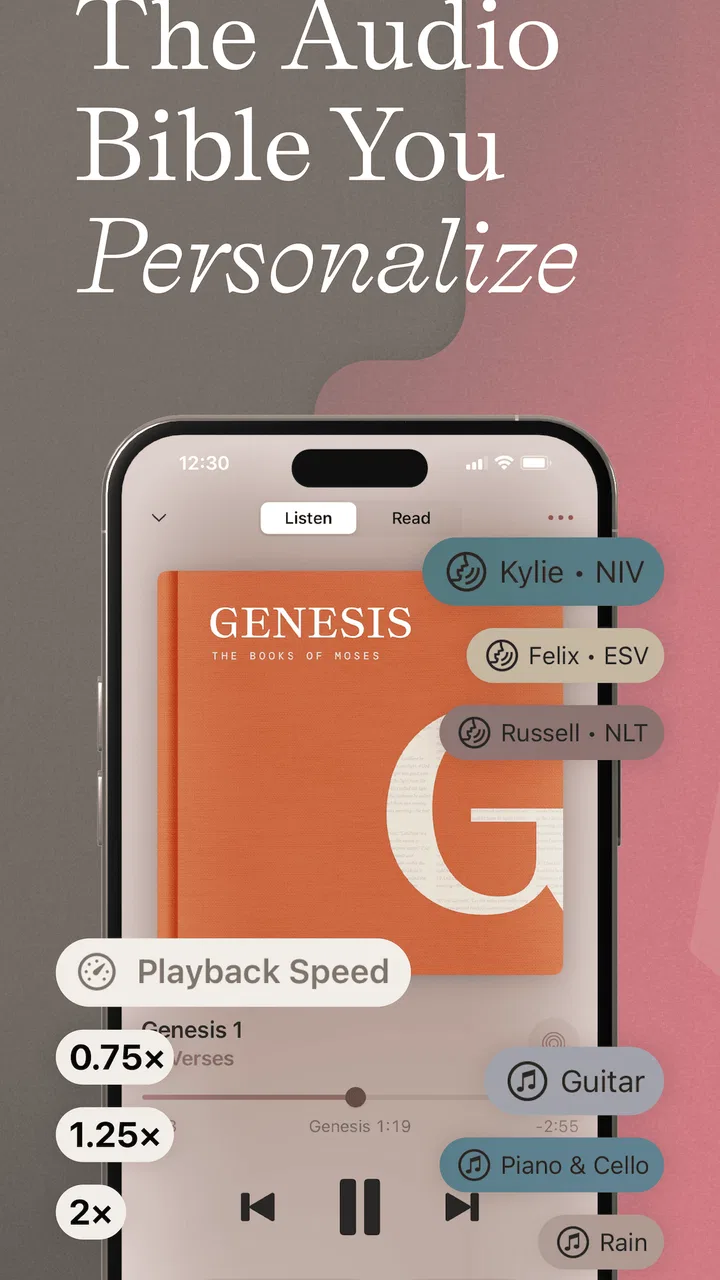
Dwell: Audio Bible offers a rich library of audio Bible versions narrated by various voice artists. It includes playlists, plans for guided listening, custom reading schedules, and background music options to enhance the listening experience. Additionally, users can bookmark favorite passages and create personalized playlists.
02Is Dwell: Audio Bible available offline?
Yes, Dwell: Audio Bible allows users to download audio content for offline listening. This feature is particularly useful for those who want to access scripture without relying on an internet connection, making it ideal for travel or areas with limited connectivity.
03Can I customize my listening experience on Dwell?
Absolutely! Dwell offers customization options such as selecting narration speed, choosing between different voices, and adding background music. Users can tailor their listening experience to suit personal preferences, ensuring a more engaging and personalized interaction with the app.
04Does Dwell: Audio Bible offer any free content?
Dwell provides some content for free, allowing users to explore the app's features and narration styles. However, a subscription is required to access the full library and premium features. The app offers various subscription plans to suit different needs and budgets.
05How user-friendly is the Dwell app?
Dwell is designed with a user-friendly interface, making it easy for users to navigate through different features and content. The app's layout is intuitive, with straightforward access to playlists, bookmarks, and settings, ensuring a seamless experience for both new and seasoned users.
Pros
- User-friendly interface for easy navigation.
- Wide range of Bible translations available.
- Customizable listening plans.
- Offline access to downloaded content.
- High-quality audio narration.
Cons
- Limited free content available.
- Requires subscription for full access.
- No video content
- audio only.
- Occasional app crashes reported.
- Limited language options beyond English.

Dwell: Audio Bible
Gallery